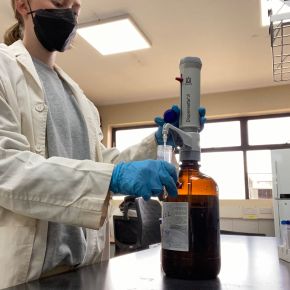
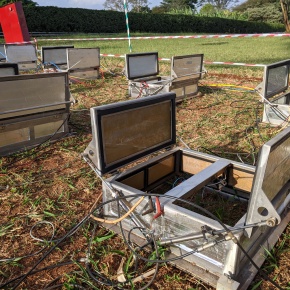
Loyapin Bondé, a plant ecologist from the Université Joseph KI-ZERBO in Burkina Faso, recently visited the Mazingira Centre, the International Livestock Research Institute’s (ILRI) environmental and climate research facility in Nairobi, Kenya. The purpose behind this visit? To connect with climate scientists to learn more about ILRI’s gas chromatography laboratory. Gas chromatography machines are designed to detect and measure greenhouse … Continue reading
Tag Archives: GHG
Full adoption of existing mitigation strategies can help meet livestock methane reduction targets by 2030
In a meta-analysis published in The Proceedings of the National Academy of Sciences (PNAS), Claudia Arndt, Leader of the Mazingira Centre at the International Livestock Research Institute in Kenya, and a score of experts from top-level institutes around the world reviewed hundreds of peer-reviewed studies for strategies designed to decrease product-based and absolute enteric methane emissions by ruminants. The research was initiated by Alexander N. Hristov at Penn State University. They found that livestock production could help meet the 1.5°C target by 2030—with the provision that the identified most effective product-based and the most effective absolute mitigation strategies be fully adopted, a goal that would require concerted action to identify and remove adoption barriers. Continue reading
Voices from the lab: highlights of my internship at Mazingira
The natural, physical, and social studies of climate change, the environment, and our food systems are vital to tackling today’s environmental challenges. For young students looking to dive deep into research, gaining field and laboratory experience is essential. My internship at the International Livestock Research Institute’s (ILRI) Mazingira Centre offered me the means of doing … Continue reading
Mazingira Centre – a role model for environmental research infrastructure in Africa
Climate change threatens the livelihoods of millions of people in Africa. The rise in global temperatures, changes in rainfall, and the increase of extreme weather conditions all pose a serious risk to the agricultural sector and food and nutrition security. At the same time, Africa is currently the most uncertain region with regard to global … Continue reading
Digging into Bomas
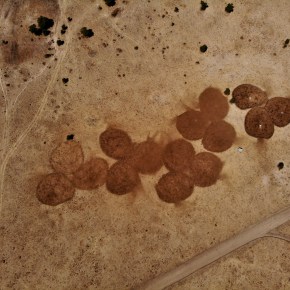
In a new international research effort, scientists from ILRI’s Mazingira Centre (Kenya), Karlsruhe Institute for Technology (Germany), and the Sustainable Agroecosystems Group at ETH Zurich (Switzerland) are teaming up to take a sharp look at the underlying mechanisms of nitrous oxide (N2O) emissions from bomas. N2O is a potent greenhouse gas, originating mostly from agricultural … Continue reading
New study finds that severe undernutrition of cattle increases their methane production
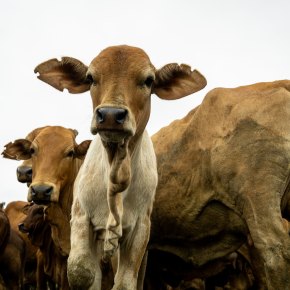
A study by researchers at the International ILRI, and partners in Germany investigated the effects of moderate to severe levels of feeding below an animal’s energy requirement on enteric methane production in young Boran steers. The study found that methane produced by an animal per unit feed intake increases as the amount of feed consumed by an animal decreases. Continue reading
Changing landscapes call for new pathways in livestock development in Ethiopia’s Afar region
Originally posted on Sustainable livestock systems:
Livestock production is the main source of livelihood in the pastoral lands of Afar in northeastern Ethiopia. But the traditional livestock-keeping way of life there has been severely affected by climate change in recent years. Rainfall has become unpredictable, and the area has been hit by unprecedented droughts and…
A new project is launched to support climate-smart livestock strategies and investments in East Africa
Originally posted on ILRI news:
It is hard to overstate the role that the livestock sector plays in ensuring food security in sub-Saharan Africa. The sector provides a vital source of income to most of the rural poor. Livestock production also provides nutritional benefits to people through their milk, meat and eggs, which are protein…
Greenhouse gas emissions from dung patches in developing countries are ‘likely highly overestimated’—New report
Originally posted on ILRI news:
Cattle herding in Kenya (photo credit: CCAFS/Cecilia Schubert). A new research paper published by scientists of the Mazingira Centre (‘mazingira’ means ‘environment’ in Swahili) of the Nairobi-based International Livestock Research Institute (ILRI) reports evidence that greenhouse gas emissions from dung patches in developing countries are ‘likely highly overestimated’ in global…
Better information and inclusive participation key to enable African farmers cope with changing climate
The Africa Climate Smart Agriculture Alliance (ACSAA) held its second annual forum in Nairobi on 11–13 October 2016 which discussed Africa’s intended nationally determined contributions (INDCs). Under the Paris Agreement that seeks to reduce global greenhouse gas (GHG) emissions, countries publicly outlined the climate actions they intended to take, known as their INDCs. A parallel session by the CGIAR Research … Continue reading