“ESSA – Earth observation and environmental sensing for climate-smart sustainable agropastoral ecosystem transformation in East Africa (2020-2024)
Objectives of the project
The project aims to contribute to the pastoralist households’ transition towards climate-smart agropastoral systems in sub-Saharan Africa (Ethiopia and Kenya) by understanding the dynamics of and interlinkages between tropical upland forest cover and semi-arid lowland landscapes, and the multifunctionality of agropastoral landscapes, through a system-wide view of food and nutrition security, diversified livelihoods and ecosystem sustainability leading to improvements.
Background
During recent years, pastures have been transformed to croplands, while the number of livestock has remained unchanged leading to less land being available for animals. The carrying capacity of pastures has decreased to a level that cannot withstand the current land use and climate pressure which subsequently leads to land degradation. Incremental adjustments in pastoralist systems currently carried out with livestock-based livelihoods is not adequate to cope with future challenges. Mechanisms that contribute to the transformational adaptation in pastoralist systems in response to climate change need to be explored, identified, analyzed and implemented. Pastoralists in East Africa are increasingly pursuing non-pastoral income and livelihood strategies to buffer against climate change impacts. Diversification of livelihood and adoption of mixed strategies combining livestock management with alternative income earning sources, such as beekeeping, is a promising option for sustainable pastoralism in Africa. However, the UNEP and GRID Arendal Gap Analysis indicates a significant lack of knowledge e.g. on alternative livelihoods and therefore recommends specific attention to be given to countries where data and information are lacking, through e.g. frequent analysis of remotely sensed data, and locally ground-truthed data.
-
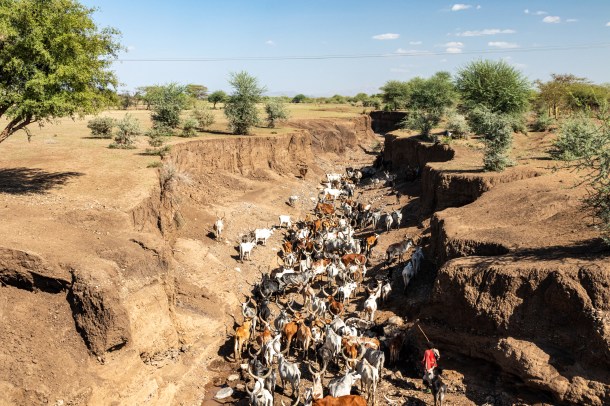
- Cattle in a dried riverbed in Afar, Ethiopia. Photo credit ILRI/Sonja Leitner
“Fluorescence measurements – the first FLOX tower in Africa ” – in partnership with University of Milano-Bicoccca, University of Milano and ILRI’s Kapiti Research Station (Since 2019)
Short Summary:
Remote sensing technologies to monitor African pastures and predict their annual production are widely used, including the IBLI team of ILRI. Vegetation fluorescence is a promising measure to improve such estimates. For this reason the first measurements of solar-induced chlorophyll fluorescence (SIF) on the African continent have started in September 2019 at Kapiti Research Station. With those measurements, the collaborating researchers from University of Milano-Bicocca, University of Milano, and ILRI’s Mazingira Centre try to improve currently available remote sensing products with direct ground measurements of SIF as well as carbon fluxes.
more here: Webpage
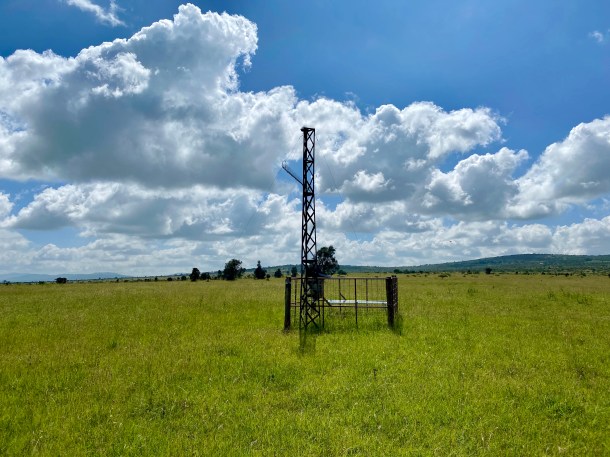
The first FloX tower on the African continent.
“Assessing the carbon balance of a large-scale dryland agriculture in semi-arid South Central Kenya” – in partnership with Agroscope, KIT Garmisch-Partenkirchen, and Ausquest Ltd. (2019-2021 and again since 2022)
Short Summary:
The overarching goal of this project is to assess the carbon budget of large-scale dryland agriculture in the semi-arid regions of Kenya. There are different land uses for the semi-arid savanna biome, common rangeland and/or dryland agriculture. A thorough assessment of either system in terms of their “climate smartness” has not been done yet. In detail, it remains unclear what the overal productivity of either of these systems is, not what the environmentla footprint of these systems is. However, such an assessment is critical to allow for sustainable food production as well as for Kenya to accurately report their greenhouse gas emissions under the Paris Climate Agreement to UNFCCC.
Specific objectives:
1. To quantify the carbon balance of a larg-scale dryland agriculture systems in South Central Kenya
2. To link the the carbon fluyx measurements to multispectral measurements of the vegetation.
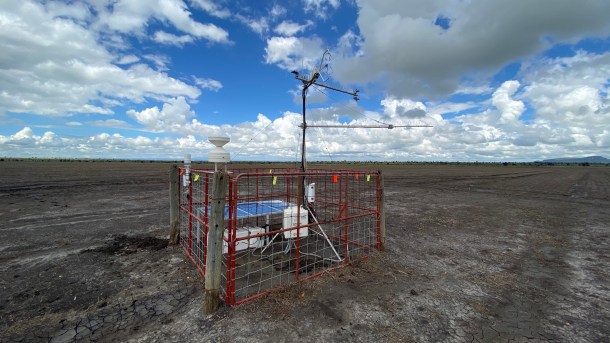
Eddy covariance tower on an agricultural field adjacent to Kapiti Research Station
 Mazingira Centre