First Drone-Based Measurement of Ruminant Methane Emissions in Africa
Uncategorized

First Drone-Based Measurement of Ruminant Methane Emissions in Africa

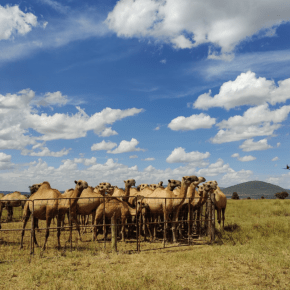
Flying a mere 9 meters above the grasslands at Kapiti, ILRI’s Research Station and Wildlife Conservancy, a drone not only took pictures of the landscape and livestock inhabitants, but was also measuring methane emissions from herds of ruminants (camels, goats, cows and sheep that digest plant-based food in a specialized stomach, resulting in methane production … Continue reading

Animal Welfare

Improving animal health: A key to sustainable livestock production and better human health

The hidden connection: Cattle, methane, and our well-being At first glance, the relationship between cattle, methane emissions and human health might not seem obvious. However, delve a little deeper, and the links become clear. Agriculture significantly contributes to global greenhouse gas (GHG) emissions, with a hefty slice of this pie attributed to ruminants like cattle, … Continue reading

Enhancing West African greenhouse gas research through expert exchange visits at ILRI’s Mazingira Centre
Uncategorized

Enhancing West African greenhouse gas research through expert exchange visits at ILRI’s Mazingira Centre

Loyapin Bondé, a plant ecologist from the Université Joseph KI-ZERBO in Burkina Faso, recently visited the Mazingira Centre, the International Livestock Research Institute’s (ILRI) environmental and climate research facility in Nairobi, Kenya. The purpose behind this visit? To connect with climate scientists to learn more about ILRI’s gas chromatography laboratory.  Gas chromatography machines are designed to detect and measure greenhouse … Continue reading

Full adoption of existing mitigation strategies can help meet livestock methane reduction targets by 2030
Africa / Climate change / Data / Emission Factors / GHG Emissions / Greenhouse Gas / ILRI / Livestock / Mazingira / Research Infrastructure / SLS

Full adoption of existing mitigation strategies can help meet livestock methane reduction targets by 2030

In a meta-analysis published in The Proceedings of the National Academy of Sciences (PNAS), Claudia Arndt, Leader of the Mazingira Centre at the International Livestock Research Institute in Kenya, and a score of experts from top-level institutes around the world reviewed hundreds of peer-reviewed studies for strategies designed to decrease product-based and absolute enteric methane emissions by ruminants. The research was initiated by Alexander N. Hristov at Penn State University. They found that livestock production could help meet the 1.5°C target by 2030—with the provision that the identified most effective product-based and the most effective absolute mitigation strategies be fully adopted, a goal that would require concerted action to identify and remove adoption barriers. Continue reading

African livestock systems’ greenhouse gas emission intensities are not as high as believed and potential avenues to reduce them
Africa / Climate change / East Africa / Emission Factors / Environment / GHG Emissions / Greenhouse Gas / ILRI / Kenya / Livestock / Mazingira / SLS

African livestock systems’ greenhouse gas emission intensities are not as high as believed and potential avenues to reduce them

Research shows that the GHG emissions intensities (EI) of smallholder livestock farms vary widely with up to 50% of the sampled smallholder livestock farms having EI similar to mean Pan-Europeans emissions intensities. Continue reading